Family Law Attorney

Family Law
There is nothing easy about going through a Family Court dispute. Whether the disagreement concerns a divorce, alimony, child support, child visitation, property division or parental rights, the process can appear to be insurmountable. And, with your money, property, and relationships with your children hanging in the balance, the stakes could not be higher. Don’t face tough times like these alone. In these situations, you need an experienced attorney whom you can trust. Turn to the legal staff of Ellis Law, LLC for the answers to your questions. With over two decades’ worth of litigation experience, you can feel confident as we guide you through this difficult process. We are based in Greenville and will work tirelessly to provide you with solutions to your problems and work to protect what you and your family have built.
Frequently Asked Questions
How quickly can I get a divorce in South Carolina?
The time frame for obtaining a divorce in South Carolina depends on your situation:
- No-fault divorce: You and your spouse must live separate and apart for one continuous year before filing.
- Fault-based divorce: For grounds such as adultery, physical cruelty, or habitual drunkenness, there is typically a 90-day waiting period after filing.
Keep in mind that disputes over other issues, such as property division or child custody, can extend the overall timeline.
How much does it cost to get divorced in South Carolina?
The filing fee for a divorce case in South Carolina is $150.00. You may also incur additional costs to request hearings with the court, to serve paperwork on the other party, etc. The total cost of a divorce varies based on how complex your case is, especially if it involves child custody or contested assets.
Consulting with an experienced family law attorney in the Greenville/Spartanburg area will give you a clearer idea of the expected costs in your situation.
Where should I file for family court: Greenville or Spartanburg?
In South Carolina, family court cases must be filed in the county where either you or your spouse currently resides.
- If both spouses live in the state, you may file in either county.
- If only one spouse lives in South Carolina, file in the county of their residence.
- If your case involves children, the court will usually prefer to hear the case where the children primarily live.
An attorney familiar with both Greenville and Spartanburg County Family Courts, as well as the other Family Courts located in the Upstate of South Carolina, can help you choose the most efficient and strategic filing location.
What should I prepare for my first family court hearing?
You must prepare and file all documents that support your case prior to the first hearing in the Court, including:
- Summons, Complaint, and the Motion for Temporary Hearing or other relief
- Financial records, including pay stubs
- Exhibits, such as communication logs with your co-parent or spouse or financial statements outlining assets to be divided
- Proof of parental involvement with the child (photos, school records, parenting plans)
Your attorney can help you organize evidence and prepare your statements so that you will make a strong, professional impression in court.
Do I need an attorney with me during mediation?
Although you are not required to have an attorney attend mediation with you, it is generally a very good idea to have an attorney with you to provide guidance and represent your interests. While mediators are neutral, they cannot provide legal advice. Having your attorney attend mediation ensures your rights are protected and that any agreements you reach are legally fair and enforceable. Your lawyer can also keep discussions productive, help you stay calm, and make sure all agreements are properly filed with the Family Court.
Can I change a court order if my situation changes after the ruling?
Could I lose custody of my children?
Custody decisions in South Carolina are always based on the best interests of the child. Judges consider factors like:
- Each parent’s ability to provide a stable home
- The child’s relationship with each parent
- Any history of abuse or neglect
- The child’s preference (if old enough)
Having a skilled child custody attorney can help you present evidence clearly and protect your parental rights.
What are common custody arrangements in South Carolina?
South Carolina recognizes two primary types of custody:
- Sole custody: One parent has primary legal and physical custody as well as decision-making authority for major decisions affecting the minor child, while the other parent may have visitation.
- Joint custody: Both parents share decision-making responsibilities and parenting time, though one parent often is designated as the primary parent for one or both of these issues.
Courts consider each family’s specific needs, aiming for arrangements that provide stability and consistent parental involvement.
Can I receive alimony or child support?
Child support and alimony are determined separately under South Carolina law:
- Child support is typically awarded unless both parties agree otherwise and is calculated based on income, number of children, visitation schedules, and other factors.
- Alimony is not guaranteed. Courts consider the length of the marriage, age and health of each spouse, earning potential, contributions to the household, and the parties’ financial needs and/or ability to provide support.
An experienced Greenville or Spartanburg family law attorney can help you evaluate what type of support may apply in your case.
How is marital property divided in South Carolina?
How can I make a good impression in Family Court?
How long does a Family Court case take in Greenville or Spartanburg?
How can we help you today?
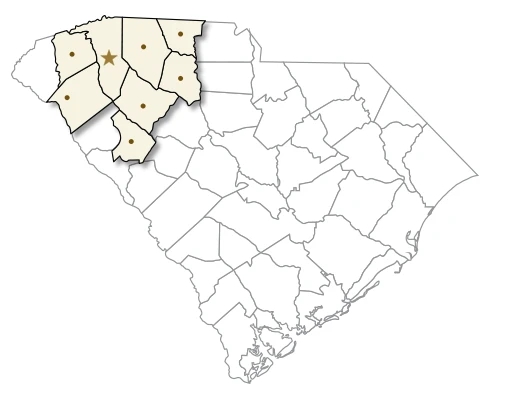
Serving the Upstate of South Carolina

Based out of Greenville, we proudly serve the upstate of South Carolina and beyond.
Anderson, Cherokee, Greenville, Greenwood, Laurens, Pickens, Spartanburg, and Union